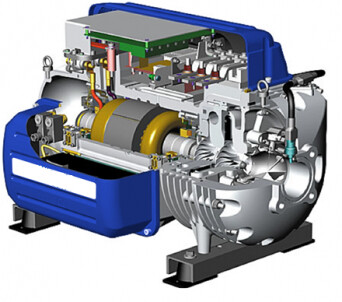
Characteristic features
The Turbocor compressor is a special two-stage radial semi-hermetic, oil-free compressor, specifically developed for R134a refrigerant. Each compressor already contains the motor and all the electrical components necessary for its control and operation.
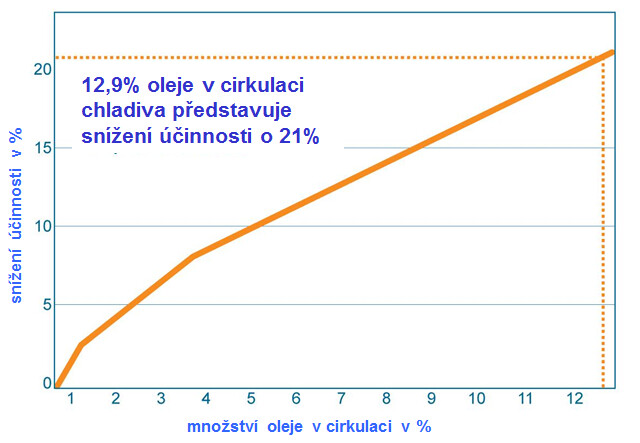
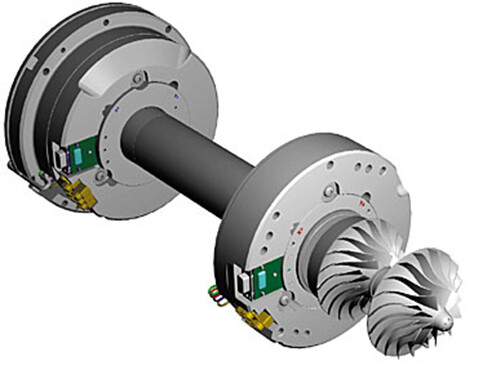
The fundamental difference from other compressors is the magnetic bearings. The entire rotor, which is the motor rotor on a common shaft with the compressor impellers, rotates on a magnetic cushion, without any friction. Thanks to the magnetic bearings, it is not necessary to lubricate the compressor with oil, the absence of which means that the refrigerant itself is not contaminated with oil, and its thermodynamic efficiency does not degrade according to this empirically determined curve.
The aforementioned properties of the Turbocor compressor result in a very high compressor efficiency, particularly at part load. A comparison with other compressor types is as follows:
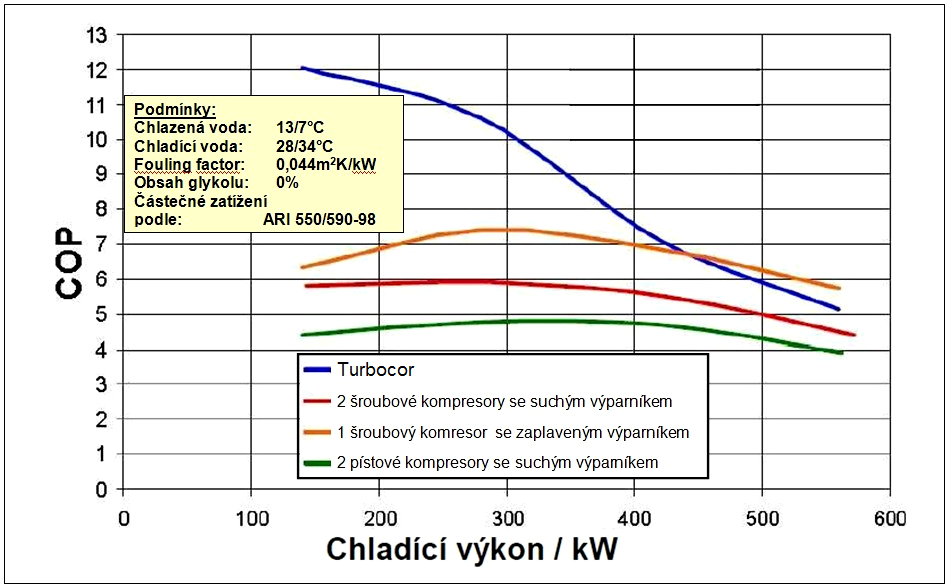
The graph reveals that cooling units with Turbocor compressors are rather average in efficiency at maximum load. However, the turning point comes when the Turbocor compressor reaches partial load, where units with Turbocor compressors achieve unparalleled high efficiency. It is important to consider the ways in which compressors reach partial load:
The condenser of a cooling unit is either always cooled by an atmospheric cooler (cooling tower, hybrid cooler, adiabatic cooler or dry cooler), or it is an atmospheric cooler itself (evaporative condenser, hybrid condenser, dry condenser). Each atmospheric cooler or condenser is designed for the most favourable possible atmospheric conditions, which however only occur for hours per year (typically air temperature +35°C for dry cooling, wet-bulb temperature 21°C for wet cooling), and for the vast majority of the year, temperatures are significantly lower than the design temperatures (see temperature curve in the Hybrid Coolers section). This means that despite the cooling unit being loaded with a constant power output corresponding to the design capacity, the compressors are operated almost constantly at partial load, and therefore in the high-efficiency range. Furthermore, it is common practice for units to be designed with a power reserve or for peak loads lasting a very limited time, or the chiller load is determined by the ambient air temperature (e.g., HVAC applications). Then, the situation arises where the cooling unit operates at reduced capacity with a lower condensing temperature for most of its operating hours, and the unit's efficiency increases steeply, significantly reducing operating costs.
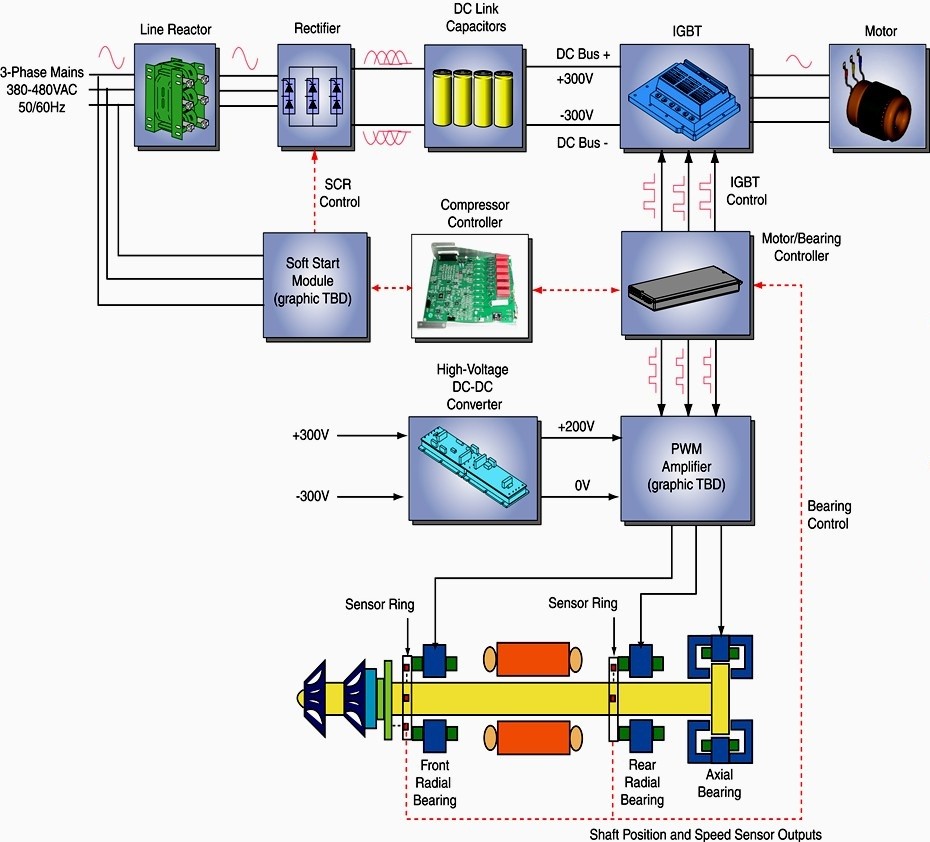
The Turbocor compressor already contains all the necessary electronics and control unit to manage its operation and magnetic bearings. The AC voltage is rectified and then inverted to the required frequency corresponding to the desired speed and output of the turbo-compressor. Electric capacitors ensure the magnetic bearings are powered during sudden power outages. The position of the shaft, floating on a magnetic cushion, is checked every 6° of its rotation, and then a correction of its position is made every further 3° of rotation.
The compressor itself has only basic control implemented within it. Commands regarding what parameters the Turbocor compressor should achieve and how it should achieve them come from the refrigeration unit's control system. In order for the Turbocor to achieve the efficiencies shown above, it places significant demands on the refrigeration unit's control system, the efficiency of the heat exchangers (evaporator and condenser), and especially on the precision of the electronic expansion valve's regulation. And this is where the major difference between individual manufacturers of refrigeration units equipped with Turbocor compressors arises. To fully utilise the Turbocor's potential, the entire design of the refrigeration unit, including the control system, must be subordinated to its needs and characteristics.
This is precisely how our cooling units are developed and constructed. However, there are also manufacturers who fit the Turbocor compressor onto slightly modified units as standard, units that are equipped with screw compressors. In real-world operation, they do not achieve high efficiencies, and the magic of Turbocor technology completely disappears, as do the anticipated savings in electricity.
The manufacturer we represent, Engie Refrigeration GmbH (formerly Axima/Cofely Refrigeration GmbH), has been manufacturing Turbocor chillers for 15 years and is one of the pioneers of this technology on the European market.